
I Am Home
A mystery-driven psychological thriller exploring isolation, uncertainty, and the darkness that lies within.
Released
Award Winning
Film
Project Overview
Conceived and produced during a period of global isolation,
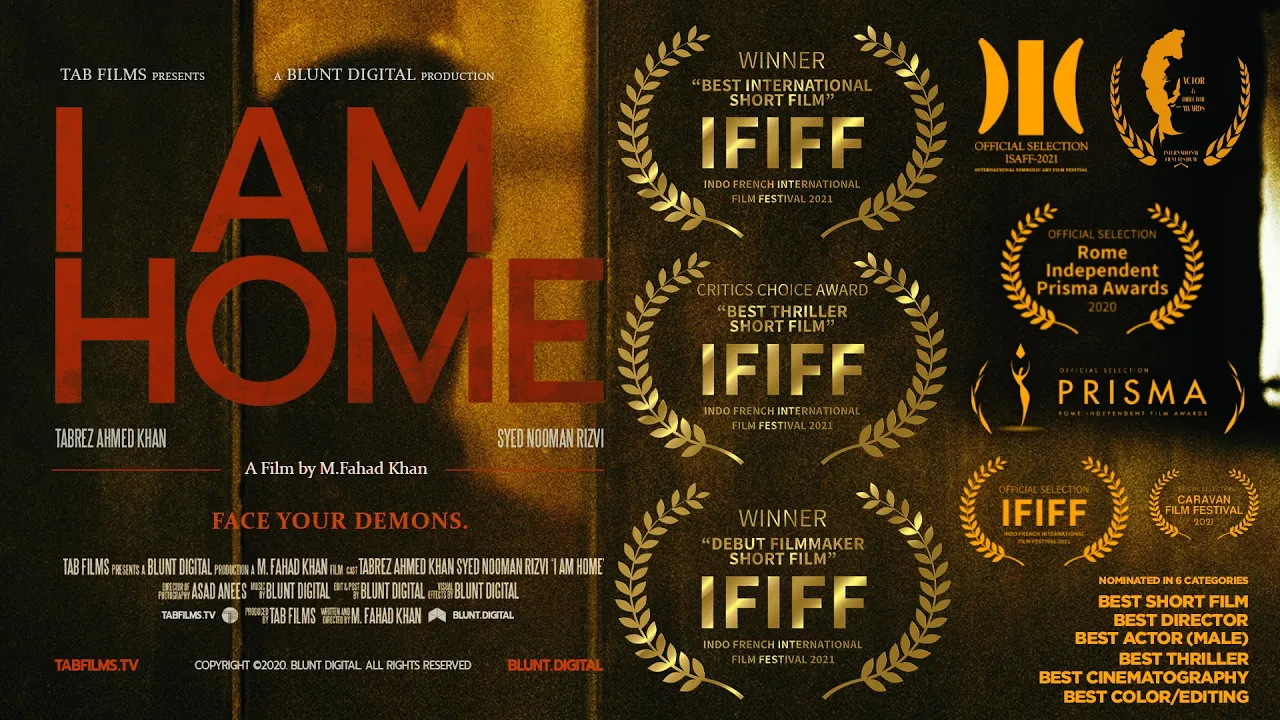
I AM HOME is an award-winning psychological thriller exploring perception, isolation, and the fragile boundary between reality and illusion. The film received international acclaim, earning eight major awards, including Best Director and Best Film. The film explores the psychological consequences of isolation, immersing audiences in an increasingly unsettling mystery where certainty slowly gives way to doubt.
Conceived and produced during a period of global isolation, I AM HOME is an award-winning psychological thriller exploring perception, isolation, and the fragile boundary between reality and illusion. The film received international acclaim, earning eight major awards, including Best Director and Best Film. The film explores the psychological consequences of isolation, immersing audiences in an increasingly unsettling mystery where certainty slowly gives way to doubt.
The story follows a seemingly ordinary man whose reality gradually begins to fracture after a series of unexplained events occur within his apartment. As paranoia grows and his understanding of the world around him begins to collapse, he is ultimately forced to confront a truth far more disturbing than anything he initially feared. Through its intimate setting and unreliable perspective, the film invites audiences to question what is real, what is imagined, and how much of ourselves remains hidden beneath the surface.
Story & Psychological Themes
Exploring isolation not as a physical condition, but as a psychological confrontation with the unknown.
At its core, I AM HOME examines what happens when an individual is left alone with their own thoughts for long enough. Developed during a period of global isolation, the film explores themes of loneliness, perception, identity, and the uneasy relationship between our external reality and internal world.
Rather than approaching these ideas through exposition, the narrative was designed to immerse audiences in a gradually escalating atmosphere of uncertainty. Ordinary routines, familiar spaces, and seemingly insignificant details become vehicles for tension, allowing psychological unease to emerge from everyday life rather than traditional genre conventions.
The film seeks to explore how isolation can alter our perception of the world around us, transforming the familiar into something increasingly unsettling while blurring the boundaries between certainty and doubt.


Cinematography & Atmosphere
Using a single location, naturalistic cinematography, and environmental symbolism to reinforce the film's themes of isolation and confinement.
The visual language of I AM HOME was built around a single guiding principle: keeping the audience trapped within the protagonist's world. The camera never leaves the apartment, allowing viewers to experience the story from within the same confined environment that shapes the character's psychological state. More than a backdrop, the apartment became the framework through which every aspect of the story was experienced, shaping the film's atmosphere, tension, and visual identity.
The location was carefully selected for its abundance of natural light, expansive city views, and the recurring presence of metal bars across its large windows. While the city beyond suggests freedom and possibility, these visual barriers create a persistent sense of confinement, subtly reinforcing the film's recurring themes of isolation and uncertainty. This contrast between openness and restriction became a recurring visual motif throughout the film.
Cinematography was approached with a naturalistic mindset, drawing inspiration from filmmakers and cinematographers whose work emphasizes realism and atmosphere over spectacle. Much of the film was photographed using available light and practical sources, preserving the feeling of an ordinary living space rather than a constructed film set. Restrained camera movement, predominantly static compositions, slow push-ins, and selective use of longer focal lengths helped create an intimate and increasingly claustrophobic viewing experience. Longer lenses were frequently favored over wider compositions, compressing the space and creating a closer relationship between the audience and the protagonist. Wider and distorted lenses were used sparingly, reserved for moments where subtle shifts in perception could heighten the film's psychological tension while maintaining the grounded realism that defines the film's visual identity.


Symbolism & Visual Storytelling
Layering subtle visual cues and recurring motifs to create a psychological landscape through symbolism, composition, and environmental storytelling.
Visual symbolism played a significant role throughout the production. Large windows revealed an expansive city beyond, yet the recurring presence of metal bars introduced a persistent sense of confinement despite the apparent freedom that existed outside. Throughout the film, architectural elements, environmental details, and recurring visual motifs were used to reinforce the atmosphere and support the film's broader psychological themes. The apartment itself became an active storytelling device, shaping both the emotional experience of the protagonist and the audience observing him.

Post Production & Narrative
Shaping suspense, pacing, and emotional tension through editorial structure and sound design.
Much of the film's psychological impact was developed during post-production. Particular attention was given to pacing, scene progression, and the gradual escalation of tension throughout the narrative. Every sequence was carefully structured to balance ambiguity with narrative clarity, ensuring audiences remained engaged while continuing to question the reality unfolding before them.
The edit was designed to reward attentive viewing, with subtle visual cues, environmental details, and recurring motifs woven throughout the film. Sound design, rhythm, and timing became essential tools in shaping the audience's emotional experience, allowing tension to emerge organically from everyday moments. Together, these elements helped reinforce the film's atmosphere of uncertainty while supporting its broader psychological themes.


Festival Journey & Recognition
International recognition for storytelling, direction, and cinematic execution.
Following its completion, I AM HOME screened internationally and received recognition across multiple film festivals, earning eight major awards including Best Director and Best Film. The film's success reflected its ability to connect with audiences through atmosphere, psychological depth, and visual storytelling while demonstrating how a focused creative vision can transform a contained production into a compelling cinematic experience.
The project's festival journey marked an important milestone, validating its creative approach and highlighting the universal resonance of its themes. Its recognition across multiple international festivals reinforced the film's impact and continues to stand as a defining achievement within the broader body of work.



Credits
Written & Directed by
M. Fahad Khan (FDK)
Production by
Blunt Digital (now FDK Studios)
Story
Fdk
Art & Creative Direction
Fdk
Cinematography
Asad Anees
Sound Design
Blunt Digital (now FDK Studios)
Editing
Fdk
Production Head
Syed Nooman Rizvi
Lighting
Syed Aashiq Shah
Makeup Artist
Aamir Shah
Zohaib Hassan
Post Production
Blunt Digital (now FDK Studios)
Color Grading
Fdk
Filmed On
Blackmagic URSA Mini 8K & RED Digital Cinema
Learn More
For complete production information, cast, crew credits, awards, and additional details about the film, please visit the official IMDb page.
More Works
©2026


I Am Home
A mystery-driven psychological thriller exploring isolation, uncertainty, and the darkness that lies within.
Released
Award Winning
Film
Project Overview
Conceived and produced during a period of global isolation, I AM HOME is an award-winning psychological thriller exploring perception, isolation, and the fragile boundary between reality and illusion. The film received international acclaim, earning eight major awards, including Best Director and Best Film. The film explores the psychological consequences of isolation, immersing audiences in an increasingly unsettling mystery where certainty slowly gives way to doubt.
The story follows a seemingly ordinary man whose reality gradually begins to fracture after a series of unexplained events occur within his apartment. As paranoia grows and his understanding of the world around him begins to collapse, he is ultimately forced to confront a truth far more disturbing than anything he initially feared. Through its intimate setting and unreliable perspective, the film invites audiences to question what is real, what is imagined, and how much of ourselves remains hidden beneath the surface.
Story & Psychological Themes
Exploring isolation not as a physical condition, but as a psychological confrontation with the unknown.
At its core, I AM HOME examines what happens when an individual is left alone with their own thoughts for long enough. Developed during a period of global isolation, the film explores themes of loneliness, perception, identity, and the uneasy relationship between our external reality and internal world.
Rather than approaching these ideas through exposition, the narrative was designed to immerse audiences in a gradually escalating atmosphere of uncertainty. Ordinary routines, familiar spaces, and seemingly insignificant details become vehicles for tension, allowing psychological unease to emerge from everyday life rather than traditional genre conventions.
The film seeks to explore how isolation can alter our perception of the world around us, transforming the familiar into something increasingly unsettling while blurring the boundaries between certainty and doubt.
Cinematography & Atmosphere
Using a single location, naturalistic cinematography, and environmental symbolism to reinforce the film's themes of isolation and confinement.
The visual language of I AM HOME was built around a single guiding principle: keeping the audience trapped within the protagonist's world. The camera never leaves the apartment, allowing viewers to experience the story from within the same confined environment that shapes the character's psychological state. More than a backdrop, the apartment became the framework through which every aspect of the story was experienced, shaping the film's atmosphere, tension, and visual identity.
The location was carefully selected for its abundance of natural light, expansive city views, and the recurring presence of metal bars across its large windows. While the city beyond suggests freedom and possibility, these visual barriers create a persistent sense of confinement, subtly reinforcing the film's recurring themes of isolation and uncertainty. This contrast between openness and restriction became a recurring visual motif throughout the film.
Cinematography was approached with a naturalistic mindset, drawing inspiration from filmmakers and cinematographers whose work emphasizes realism and atmosphere over spectacle. Much of the film was photographed using available light and practical sources, preserving the feeling of an ordinary living space rather than a constructed film set. Restrained camera movement, predominantly static compositions, slow push-ins, and selective use of longer focal lengths helped create an intimate and increasingly claustrophobic viewing experience. Longer lenses were frequently favored over wider compositions, compressing the space and creating a closer relationship between the audience and the protagonist. Wider and distorted lenses were used sparingly, reserved for moments where subtle shifts in perception could heighten the film's psychological tension while maintaining the grounded realism that defines the film's visual identity.
Symbolism & Visual Storytelling
Layering subtle visual cues and recurring motifs to create a psychological landscape through symbolism, composition, and environmental storytelling.
Visual symbolism played a significant role throughout the production. Large windows revealed an expansive city beyond, yet the recurring presence of metal bars introduced a persistent sense of confinement despite the apparent freedom that existed outside. Throughout the film, architectural elements, environmental details, and recurring visual motifs were used to reinforce the atmosphere and support the film's broader psychological themes. The apartment itself became an active storytelling device, shaping both the emotional experience of the protagonist and the audience observing him.
Post Production & Narrative
Shaping suspense, pacing, and emotional tension through editorial structure and sound design.
Much of the film's psychological impact was developed during post-production. Particular attention was given to pacing, scene progression, and the gradual escalation of tension throughout the narrative. Every sequence was carefully structured to balance ambiguity with narrative clarity, ensuring audiences remained engaged while continuing to question the reality unfolding before them.
The edit was designed to reward attentive viewing, with subtle visual cues, environmental details, and recurring motifs woven throughout the film. Sound design, rhythm, and timing became essential tools in shaping the audience's emotional experience, allowing tension to emerge organically from everyday moments. Together, these elements helped reinforce the film's atmosphere of uncertainty while supporting its broader psychological themes.
Festival Journey & Recognition
International recognition for storytelling, direction, and cinematic execution.
Following its completion, I AM HOME screened internationally and received recognition across multiple film festivals, earning eight major awards including Best Director and Best Film. The film's success reflected its ability to connect with audiences through atmosphere, psychological depth, and visual storytelling while demonstrating how a focused creative vision can transform a contained production into a compelling cinematic experience.
The project's festival journey marked an important milestone, validating its creative approach and highlighting the universal resonance of its themes. Its recognition across multiple international festivals reinforced the film's impact and continues to stand as a defining achievement within the broader body of work.
Credits
Written & Directed by
M. Fahad Khan (FDK)
Production by
Blunt Digital (now FDK Studios)
Story
Fdk
Art & Creative Direction
Fdk
Cinematography
Asad Anees
Sound Design
Blunt Digital (now FDK Studios)
Editing
Fdk
Production Head
Syed Nooman Rizvi
Lighting
Syed Aashiq Shah
Makeup Artist
Aamir Shah
Zohaib Hassan
Post Production
Blunt Digital (now FDK Studios)
Color Grading
Fdk
Filmed On
Blackmagic URSA Mini 8K & RED Digital Cinema
Learn More
For complete production information, cast, crew credits, awards, and additional details about the film, please visit the official IMDb page.
More Works
©2026
I Am Home
A mystery-driven psychological thriller exploring isolation, uncertainty, and the darkness that lies within.
Released
Award Winning
Film
Project Overview
Conceived and produced during a period of global isolation, I AM HOME is an award-winning psychological thriller exploring perception, isolation, and the fragile boundary between reality and illusion. The film received international acclaim, earning eight major awards, including Best Director and Best Film. The film explores the psychological consequences of isolation, immersing audiences in an increasingly unsettling mystery where certainty slowly gives way to doubt.
The story follows a seemingly ordinary man whose reality gradually begins to fracture after a series of unexplained events occur within his apartment. As paranoia grows and his understanding of the world around him begins to collapse, he is ultimately forced to confront a truth far more disturbing than anything he initially feared. Through its intimate setting and unreliable perspective, the film invites audiences to question what is real, what is imagined, and how much of ourselves remains hidden beneath the surface.
Story & Psychological Themes
Exploring isolation not as a physical condition, but as a psychological confrontation with the unknown.
At its core, I AM HOME examines what happens when an individual is left alone with their own thoughts for long enough. Developed during a period of global isolation, the film explores themes of loneliness, perception, identity, and the uneasy relationship between our external reality and internal world.
Rather than approaching these ideas through exposition, the narrative was designed to immerse audiences in a gradually escalating atmosphere of uncertainty. Ordinary routines, familiar spaces, and seemingly insignificant details become vehicles for tension, allowing psychological unease to emerge from everyday life rather than traditional genre conventions.
The film seeks to explore how isolation can alter our perception of the world around us, transforming the familiar into something increasingly unsettling while blurring the boundaries between certainty and doubt.
Cinematography & Atmosphere
Using a single location, naturalistic cinematography, and environmental symbolism to reinforce the film's themes of isolation and confinement.
The visual language of I AM HOME was built around a single guiding principle: keeping the audience trapped within the protagonist's world. The camera never leaves the apartment, allowing viewers to experience the story from within the same confined environment that shapes the character's psychological state. More than a backdrop, the apartment became the framework through which every aspect of the story was experienced, shaping the film's atmosphere, tension, and visual identity.
The location was carefully selected for its abundance of natural light, expansive city views, and the recurring presence of metal bars across its large windows. While the city beyond suggests freedom and possibility, these visual barriers create a persistent sense of confinement, subtly reinforcing the film's recurring themes of isolation and uncertainty. This contrast between openness and restriction became a recurring visual motif throughout the film.
Cinematography was approached with a naturalistic mindset, drawing inspiration from filmmakers and cinematographers whose work emphasizes realism and atmosphere over spectacle. Much of the film was photographed using available light and practical sources, preserving the feeling of an ordinary living space rather than a constructed film set. Restrained camera movement, predominantly static compositions, slow push-ins, and selective use of longer focal lengths helped create an intimate and increasingly claustrophobic viewing experience. Longer lenses were frequently favored over wider compositions, compressing the space and creating a closer relationship between the audience and the protagonist. Wider and distorted lenses were used sparingly, reserved for moments where subtle shifts in perception could heighten the film's psychological tension while maintaining the grounded realism that defines the film's visual identity.
Symbolism & Visual Storytelling
Layering subtle visual cues and recurring motifs to create a psychological landscape through symbolism, composition, and environmental storytelling.
Visual symbolism played a significant role throughout the production. Large windows revealed an expansive city beyond, yet the recurring presence of metal bars introduced a persistent sense of confinement despite the apparent freedom that existed outside. Throughout the film, architectural elements, environmental details, and recurring visual motifs were used to reinforce the atmosphere and support the film's broader psychological themes. The apartment itself became an active storytelling device, shaping both the emotional experience of the protagonist and the audience observing him.

Post Production & Narrative
Shaping suspense, pacing, and emotional tension through editorial structure and sound design.
Much of the film's psychological impact was developed during post-production. Particular attention was given to pacing, scene progression, and the gradual escalation of tension throughout the narrative. Every sequence was carefully structured to balance ambiguity with narrative clarity, ensuring audiences remained engaged while continuing to question the reality unfolding before them.
The edit was designed to reward attentive viewing, with subtle visual cues, environmental details, and recurring motifs woven throughout the film. Sound design, rhythm, and timing became essential tools in shaping the audience's emotional experience, allowing tension to emerge organically from everyday moments. Together, these elements helped reinforce the film's atmosphere of uncertainty while supporting its broader psychological themes.
Festival Journey & Recognition
International recognition for storytelling, direction, and cinematic execution.
Following its completion, I AM HOME screened internationally and received recognition across multiple film festivals, earning eight major awards including Best Director and Best Film. The film's success reflected its ability to connect with audiences through atmosphere, psychological depth, and visual storytelling while demonstrating how a focused creative vision can transform a contained production into a compelling cinematic experience.
The project's festival journey marked an important milestone, validating its creative approach and highlighting the universal resonance of its themes. Its recognition across multiple international festivals reinforced the film's impact and continues to stand as a defining achievement within the broader body of work.
Credits
Written & Directed by
M. Fahad Khan (FDK)
Production by
Blunt Digital (now FDK Studios)
Story
Fdk
Art & Creative Direction
Fdk
Cinematography
Asad Anees
Sound Design
Blunt Digital (now FDK Studios)
Editing
Fdk
Production Head
Syed Nooman Rizvi
Lighting
Syed Aashiq Shah
Makeup Artist
Aamir Shah
Zohaib Hassan
Post Production
Blunt Digital (now FDK Studios)
Color Grading
Fdk
Filmed On
Blackmagic URSA Mini 8K & RED Digital Cinema
Learn More
For complete production information, cast, crew credits, awards, and additional details about the film, please visit the official IMDb page.
More Works
©2026
